The board and starting position
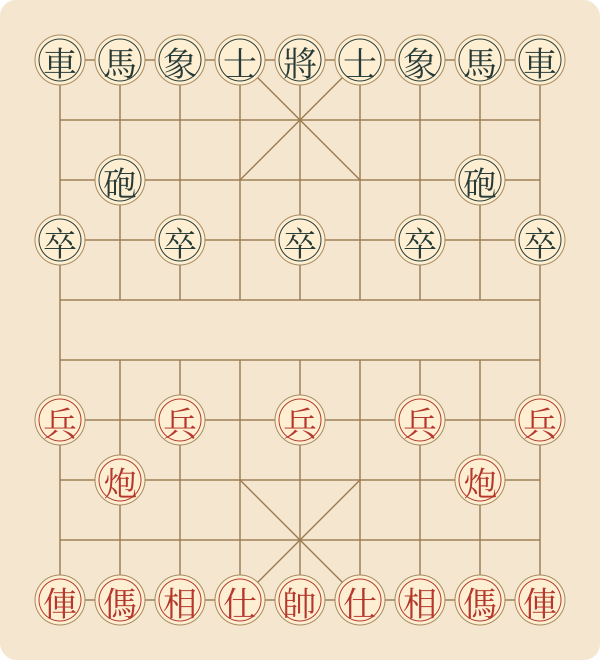
The board has 9 vertical lines and 10 horizontal lines, forming 90 intersections. Pieces stand on these intersections, not inside the squares. A one-point move means moving to the next intersection.
The river and palaces
The river separates the two halves between the fifth and sixth ranks. Each side has a palace at the centre of its back three ranks: a 3 × 3 set of intersections marked by diagonal lines. Generals and advisors must stay in their own palace; elephants cannot cross the river.
16 pieces on each side
Each army has 1 general, 2 advisors, 2 elephants, 2 chariots, 2 horses, 2 cannons and 5 soldiers. The two colours may use different Chinese characters for the same piece, but their movement rules are identical.
Arrange your army
Counting ranks from your own back edge, the first rank is: chariot – horse – elephant – advisor – general – advisor – elephant – horse – chariot. Place cannons on the third rank in columns 2 and 8, and soldiers on the fourth rank in columns 1, 3, 5, 7 and 9. The opponent has the same mirrored formation.
How the seven pieces move
The paired symbols below show the Red and Black versions of each piece. A move must follow the piece's rule and leave your own general safe.
Turns and captures
Each turn moves one of your own pieces from its current intersection to a different, legal destination. You cannot pass your turn.
Move or capture
An empty destination is a normal move. If an opposing piece occupies the destination and the capture is legal, remove it and put your piece there. A captured piece does not return to the board. You may choose any legal move; a capture is not compulsory simply because one is available.
Friendly pieces and obstructions
You cannot capture your own piece or place two pieces on the same point. Check the whole route: chariots need a clear line, horses a clear leg, elephants a clear eye, and capturing cannons exactly one screen.
Keep your general safe
A move is illegal if your general is still attacked afterwards, even if the moving piece follows its own movement rule. This includes moving away the only piece separating the two generals.
Check and facing generals
A general is in check when an opposing piece threatens to capture it. The player in check must remove every such threat immediately on the next move.
Ways to escape check
Move the general to a safe point, capture the checking piece, or block its attack where the piece's movement allows it. Against a horse, blocking its leg can work. Against a cannon, moving the screen away or adding a second screen can work. Every response must leave the general safe from all opposing pieces.
The generals cannot face each other
The generals may stand on the same file only while at least one piece separates them. Neither general may move onto an open file facing the other, and no other piece may move away to expose that line.
Checkmate
If the general is in check and there is no legal response, the checked side loses immediately. A single check is not a win if the opponent can still escape.
Winning and losing
Capturing more material does not itself win the game. The result depends on the general's safety, the available legal moves and the game's finish conditions.
Checkmate or no legal move
You win if you checkmate the opposing general or leave your opponent with no legal move. In Xiangqi, having no legal move is a loss even when the general is not in check. This is often called a stalemate loss.
Resignation and time
A player who resigns loses. In a timed game, a player whose clock runs out loses. If the chosen time control has an increment, it is added after a completed move; check the time control before starting.
Draws and repetition at ChessPlayX
Repeated moves do not always lead to a draw. The current games on ChessPlayX distinguish neutral repetition from prohibited perpetual check or chase as follows.
Draw by agreement
One player offers a draw and the opponent accepts. Offering a draw alone does not end the game; continue playing and watching your clock until the offer is accepted.
Repetition without a one-sided violation
A repeated position has the same piece arrangement and the same side to move. On its fourth occurrence, the game is drawn if neither side must change its play: neither is violating the repetition rules, or both have the same type of repeating conduct. A third occurrence alone is not an automatic draw.
Perpetual check and chase
Perpetual check means checking on every turn of a repeating cycle. Prohibited perpetual chase means repeatedly threatening the same target and forcing the opponent to meet the threat. If one side checks perpetually while the other chases perpetually, the checking side must change its play. ChessPlayX warns the responsible side at the third occurrence; continuing the violation to the fourth occurrence after the warning loses the game.
Not every attack is a prohibited chase
A capture threat must be legal. Chasing a protected piece is normally exempt if its defender can legally recapture. Genuine exchanges between the same piece types are also exempt, as are attacks by a general or soldier and attacks on a soldier that has not crossed the river. A horse or cannon repeatedly chasing a chariot can still be prohibited even if the chariot is protected.
50 moves by each side without a capture
If the game has not already ended, 100 consecutive individual moves without a capture result in a draw, equivalent to 50 moves by each side. A soldier move does not restart this count; a capture does.
Common situations to remember
Before moving, check the destination, the path and whether your general will remain safe. These examples help avoid common mistakes.
A cannon cannot capture without a screen
Even on the same rank or file, a cannon cannot capture an adjacent enemy piece because there is no screen between them. It also cannot jump over a screen simply to land on an empty point.
Crossing the river does not allow a double move
On any turn, a soldier moves just one point: forward or, after crossing the river, sideways. It cannot combine the two directions or move diagonally, including when capturing.
A valuable capture cannot take priority over check
Even if you can capture a chariot or cannon, that move is illegal if your general remains in check. Escaping every check takes priority over gaining material.
Rules and references
- World Xiangqi Rules 2018 — World Xiangqi Federation
This guide describes play on ChessPlayX. Platform-specific conventions are stated in the relevant sections; tournament administration may differ.