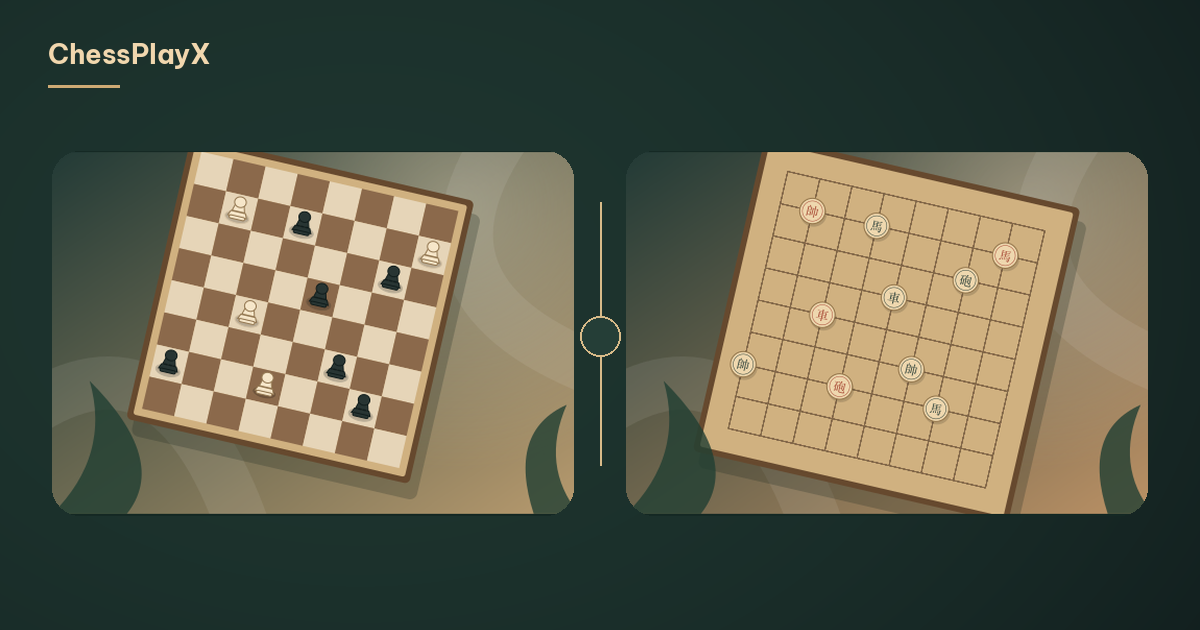
Chess and Xiangqi are two-player strategy games built around the safety of a royal piece. Chess uses 64 squares; Xiangqi uses 90 intersections, a river and two palaces. Both start with 16 pieces per side, but their movement and end-of-game rules are different. Knowing one helps you learn the other, without making the rules interchangeable.
The differences at a glance
Scroll the table sideways to compare all columns.
| Feature | Chess | Xiangqi |
|---|---|---|
| Playing area | 8 × 8 squares, 64 squares | 9 files × 10 ranks, 90 intersections |
| Starting pieces | 16 per side | 16 per side |
| Royal piece | King can move across the board | General stays inside a 3 × 3 palace |
| Long-range pieces | Rook, bishop and queen | Chariot and cannon; no queen |
| Horse or knight | Knight jumps over intervening pieces | Horse can be blocked at its leg |
| Cannon | No equivalent | Needs exactly one intervening piece to capture |
| Pawn or soldier | Can promote on the last rank | Gains sideways movement after crossing the river; never promotes |
| Special moves | Castling and en passant, under specific conditions | Neither castling nor en passant |
| No legal move, not in check | Stalemate: draw | Loss for the player unable to move |
Squares, intersections and the river
In chess, you place pieces inside squares. A bishop remains on one colour throughout the game. In Xiangqi, pieces sit on intersections. The river separates the two sides: elephants cannot cross it, while soldiers gain the ability to move sideways after crossing. A soldier still cannot move backwards.
The general and advisors remain inside their palace. The two generals may not face each other along an open file. These restrictions make lines through the centre and the palace particularly important.
Three habits to relearn
Check the horse's leg. A chess knight can jump over a crowded position. A Xiangqi horse needs the adjacent orthogonal point on its route to be clear. A piece placed there can stop the horse from reaching its apparent destination.
Count the cannon's screen. A cannon moves along a clear rank or file when it is not capturing. To capture, it jumps over exactly one intervening piece, of either colour. Adding or removing that screen can change a position immediately.
Recheck the endgame. A chess pawn can become a queen, rook, bishop or knight on its last rank. A Xiangqi soldier does not promote. Also, a position with no legal move is not automatically a draw in Xiangqi.
What transfers between the games?
Looking for checks, captures and threats helps in both. So do developing pieces, coordinating attacks and keeping the royal piece safe. However, the value of a piece depends on the position and the game; a chess piece-value chart is not a scoring system for Xiangqi.
For a first transition, try a short game without a tight clock. Before every move, check the horse's leg, cannon screens and the generals' file. Read the chess rules and the Xiangqi rules when a position feels unfamiliar.
Frequently asked questions
Is Xiangqi just chess with different pieces?
No. They share a royal-piece objective and some tactical ideas, but Xiangqi has a different board, movement restrictions, cannon captures and a different stalemate result.
Is chess or Xiangqi harder?
There is no universal answer. Familiarity, time controls and your current level matter. Both support deep calculation and long-term planning; knowing one does not establish an equivalent rating in the other.
Can I use the same rules for repeated positions?
No. Chess repetition and Xiangqi rules for repeated checking or chasing are different. Consult the chosen ruleset rather than assuming every repeated position is a draw.
Sources and next steps
- FIDE Laws of Chess, sections 3 and 5: movement, promotion, castling, en passant and stalemate.
- World Xiangqi Federation: World Xiangqi Rules: movement, legal positions and game results.
- Continue with Xiangqi vs Go, or choose chess or Xiangqi to play.