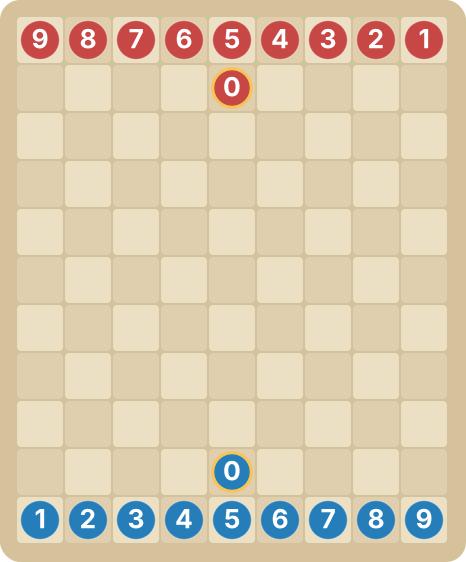
How do you set up the board?
The board has 99 squares: 9 columns and 11 rows. Each side has one piece of each number from 0 to 9. From your own viewpoint, arrange 1–9 from left to right on the back row; place zero in the fifth square of the second row. The two sides therefore appear reversed when viewed from one end. Zero stays on its starting square throughout the game. On ChessPlayX, Blue moves first and the players alternate turns.
How do arithmetic captures work?
A capture needs two friendly pieces in a straight line: the attacker A, then a support B immediately in front of it, then the enemy target farther along the same direction. A jumps over B and replaces the target; B stays put. Calculate A with B to find the distance from the support to the target. The cards below use attacker 7 and support 4.
Addition
Use the units digit of A + B. A result ending in zero cannot produce a capture.
7 + 4 = 11 → distance 1
Subtraction
Calculate A − B in that order. Only a positive result works; do not reverse the numbers or take the absolute difference.
7 − 4 = 3 → distance 3
Multiplication
Use the units digit of A × B. The target must be that far beyond the support and still on the board.
7 × 4 = 28 → distance 8
Division
Divide A by B and use either the integer quotient or the remainder, provided it is positive. Division by zero is not allowed.
7 ÷ 4 = 1 remainder 3 → distance 1 or 3
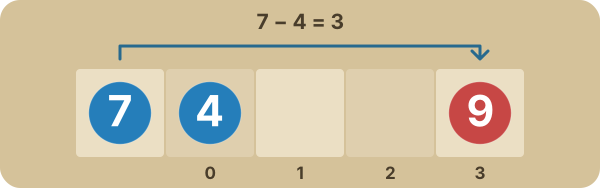
Captures may follow a rank, file or diagonal. Every square between the support and target must be empty, the target must be an opponent’s piece, and the destination must remain on the board. Only the adjacent support may be jumped. A distance of zero never captures; each capture removes one enemy piece.
How do the pieces move?
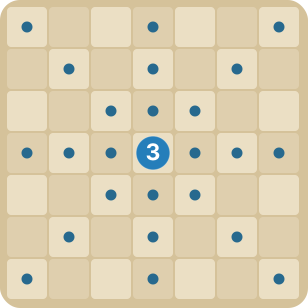
Up to the piece’s number
A nonzero piece n can move 1 to n squares in any of eight directions: horizontally, vertically or diagonally. It need not move the full distance. Zero never moves.
A clear path to an empty square
An ordinary move cannot jump any piece, change direction or land on an occupied square. Capturing uses the separate support-and-arithmetic rule above.
One move per turn
Make one legal move or capture, then the turn passes. Passing is not allowed and capturing is optional. The n-square limit applies to ordinary moves; a capture uses the arithmetic distance from the support.
When does the game end?
Win
Capture the opponent’s zero to win immediately, regardless of the other pieces remaining or the captured-point total.
Loss
A player with no legal move on their turn loses. Resigning, or running out of time in a timed room, also loses.
Draw
The same placement, values and colours of pieces with the same player to move occurring for the third time automatically draws; the occurrences need not be consecutive. In a room, an agreed draw requires the opponent to accept.
Captured numbers are added to the displayed score for information only. This ChessPlayX mode is won by capturing zero or the opponent losing; reaching a point total does not win. There is no automatic draw after a fixed number of quiet moves.
What should beginners watch for?
Protect your zero
Before moving a defender, check whether an opposing pair now has a clear arithmetic capture toward your zero.
Build useful pairs
Keep an attacker and support adjacent on the intended line. An isolated piece can move but cannot capture by itself.
Try all four operations
The same pair can create several capture distances. Check the units digit, subtraction order, quotient and remainder before choosing a plan.
Count from the support
Treat the support’s square as the starting point; the next square is step 1. Check the whole path and the destination, not just the calculation.
Frequently asked questions
Which side moves first?
Blue moves first on ChessPlayX. Thereafter each player makes one legal move or capture per turn.
Can zero move or help a capture?
Zero cannot move or capture. On ChessPlayX it can be the stationary support for another piece n: n + 0 and n − 0 both give distance n. Multiplication by zero gives no capture, and division by zero is not allowed.
Is capture distance measured from the attacker?
No. It is measured from the adjacent support toward the target. A result of 3 means the target is three squares beyond the support, so the attacker travels four squares in total. The target’s number is irrelevant.
Can I swap the numbers for subtraction?
No. Subtract the support from the attacker: A − B. An attacker 4 with support 7 cannot capture by subtraction; 4 − 7 is negative. An attacker 7 with support 4 can use distance 3.
Does division always give two capture distances?
No. Only positive quotient or remainder values can be used, and they can coincide. For 7 ÷ 4, the quotient is 1 and remainder is 3. For 8 ÷ 4, only distance 2 works because the remainder is zero. A target and clear path are still required.
Does Math Chess use check and checkmate?
This ChessPlayX mode does not forbid moves that leave zero under attack as chess forbids leaving its king in check. Protect zero yourself: its actual capture ends the game. Having no legal move is also a loss.
Does a higher captured score win?
No. The displayed score sums the values of captured pieces for reference. It does not replace capture of zero or the other game-ending conditions in this mode.
Who can learn Math Chess?
Anyone familiar with basic addition, subtraction, multiplication and division can start. Practise ordinary moves first, then set up an adjacent pair and count capture distances. Use the same-device practice mode to try both sides.
Rules and references
This guide describes the capture-zero mode played on ChessPlayX. VNU’s article provides background on Vũ Văn Bảy’s game, the 99-square board and the fixed zero. The repetition, no-legal-move and score conventions are explained above; tournament or point-based rules may differ.